


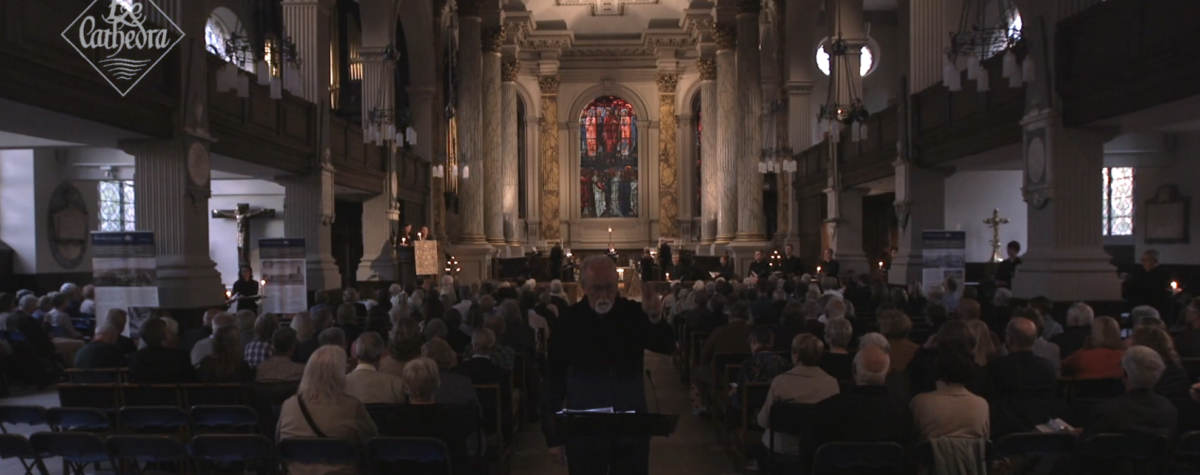
“scintillatingly sung … pure enchantment” – Church Times review of Purcell’s The Indian Queen
“supremely polished instrumental playing … scintillatingly sung … pure enchantment.
“Skidmore distributed the solos admirably around the singers. Each without exception was top-quality. That they blended so perfectly within the choir was another source of satisfaction.”
Read the Church Times review of Purcell’s The Indian Queen, part of Birmingham Festival of Early Music, and catch it again at the London Festival of Baroque Music at St John’s Smith Square in May. Or snap up the last few tickets to hear us perform Fire burning in Snow: Latin American Baroque Music in Warwick on 26 March. See forthcoming concerts.
Monteverdi, Maria quid ploras
“vivid and dramatic… vibrant, exciting playing” – read the review of Purcell’s The Indian Queen
‘How should one define Purcell’s last major work, The Indian Queen? … However we term it, Purcell’s input to The Indian Queen contains some vivid and dramatic music… it remains – at its best – quite meaty stuff, as this ultra-reliable and spirited revival by Ex Cathedra, inspired by its founder and conductor, Jeffrey Skidmore, showed…
‘Ex Cathedra’s instrumental team, under Skidmore’s shrewd, experienced nursing, shone at every point: organ, archlute, harp and all strings, solo cello especially. This was vibrant, exciting playing. And to cap it all, some thrilling contributions from a very impudent and insistent mixed drums and intermittent percussion, with fabulous rhythmic alertness by the phenomenally nimble Simone Rebello.
‘We are not finished with the charms of Central and South America. Before this Aztec quasi-drama Skidmore had some very appropriate music to offer as a first half.
‘His incredibly fresh and persistent personal researches in sundry music libraries of (at least) Mexico and Bolivia (and in part in the United States) have earned him widespread praise, not least for the most obvious publically available fruits of his labours: the series of superb recordings he has made with his choir on the Hyperion label. Here – in the handsomely refurbished Birmingham Town Hall, one of Ex Cathedra’s welcoming regular venues, thanks not least to a very acceptable acoustic – he focused especially on Juan de Araujo (1646-1712), Spanish-born, later organist of Lima cathedral in the Peruvian capital, and for three decades Maestro de Capilla of the wealthy cathedral at Sucre, one of the major centres in central Bolivia…
‘The spirit of the dance lasted right through to the last Araujo piece, ‘¡Ay andar!’: ‘Come on, shake those tambourines… You’ll be condemned to chilblains if you try to dodge the dancing’: a perfect outlet for the impish drum section, before a beautiful and moving recessional emptied the stage in conclusion of a beautifully managed first half: a scrumptious appetiser for the Purcell to come.’
Read the full review at www.seenandheard-international.com.
Don’t miss more Latin American Baroque Music at St Mary’s Church, Warwick on 26 March, and a repeat of this concert for the London Festival of Baroque Music at St John’s Smith Square on 17 May.
Panufnik, Celestial Bird CD preview
“an almost magical delicacy” – review of A Time to be Born and a Time to Die premiere
‘Alec Roth has been the choir Ex Cathedra’s adopted composer for some ten years. His contributions to its repertoire have been numerous and worth while: sometimes shorter pieces adapted well to the choir’s needs, sometimes more extensive, such as his 40-part motet Earthrise.
‘The thrust of his newest work, A Time to be Born and a Time to Die (after Ecclesiastes 3: “To everything there is a season. . .”), given its world première at the University of Birmingham’s Bramall Concert Hall, is to a degree both religious — Christmas and Easter — and humanist, recalling, perhaps, Roth’s close collaborations with the Indian-born writer Vikram Seth.
‘Commissioning new work may sometimes be a gamble, but a familiarity between composer and ensemble, as here in Roth’s close relationship with Jeffrey Skidmore and Ex Cathedra, is always an advantage. This new cantata excelled in many respects: in its design and conception; in its contrasting moods and tempi; in its subtle colourings; and in its beautifully judged writing for choir and soloists. Avoiding the obvious, Roth cherishes the naïve and intimate in exploring, and polishing, his chosen texts.
‘One might have harboured doubts about the last. Can one weave a truly coherent whole from such sources as Blake, Traherne, Yeats, Kipling, the doomed young aristocrat Chidiock Tichborne, Longfellow, and more?
‘Tichborne, writing the night before his execution, adjusting to the finite — or infinite? — offers a clue; for Roth has created not a patchwork, but an enticing floral eiderdown, rich in imagery and in musical finery (Bach is a great inspiration) which transits from the innocence of birth to an embracing of imminent death (“My glass is full, and now my glass is run, And now I live, and now my life is done”).
‘Kipling’s double-edged “A birth and a death” (reflecting love for his feared-dead soldier offspring) makes the link between lines that evoke the certainty of death or parallel the nativity story. This launches out with “Haste, little captive, burst thy prison doors! Launch on the living world, and spring to light!”, and — a surprise, perhaps — Thom Gunn’s “Baby Song” (“Why don’t they simply put me back Where it is warm and wet and black?”).
‘The former lines (Anna Laetitia Barbauld), set for solo bass (Greg Skidmore), are lithe, elegant, and expressive. Gunn’s (as usual, rhyming) poem, pleading and emotional, with fabulously crafted double-bass solo, was exquisitely delivered by the sensitive, gorgeously voiced tenor Samuel Boden.
‘The alto soloist, Martha McLorinan, with a richly glowing tone, had a touching Aztec cradle song — a moving interpolation; and nurtured finely the lilting setting of a tragic mini-ballad by Mary Coleridge.
‘Enchanting hints of bassoon and flute tinge the Traherne verses, sung by the soprano Katie Trethewey. Much of this rewarding work has an almost magical delicacy: time and again, Roth enhances rather than diminishes his poets. Skilled word-painting is an art at which Britten excelled (occasionally you sense a distant echo); and it is crucial here.
‘There is Tippett, too, in the mix; for Yeats’s “Cradle Song” enfolds patterns that have the flavour of blues or spirituals. Yet nothing is overdone. It is the spareness of the writing (including, here, period strings) which gives Roth’s work its innocent and intimate atmosphere. He succeeds in adjusting styles — the Kipling vision of Mary Magdalene comes close to opera — while maintaining a persuasively coherent whole. Walt Whitman’s “To one shortly to die”, with some scintillating a cappella singing, feels, paradoxically, like a lullaby.
‘Entrancingly introduced by rippling viola, the choral setting of Longfellow revisits the spiritual or blues. The gently symbolic text bespeaks resignation (“the hostler calls. . . The day returns but nevermore returns the traveller, to the shore. . .”). The endless cycle of life completes its transition, and concludes: the promise of the title has indeed been fulfilled.’