


In 40 Parts: Spem in alium, Ex Cathedra, St Martin-in-the-Fields review – transcendent testimony to Tallis’s continued ability to inspire.
A fitting celebration of artistic director Jeffrey Skidmore’s vision and dedication
by Rachel Halliburton, Friday, 23 October 2026
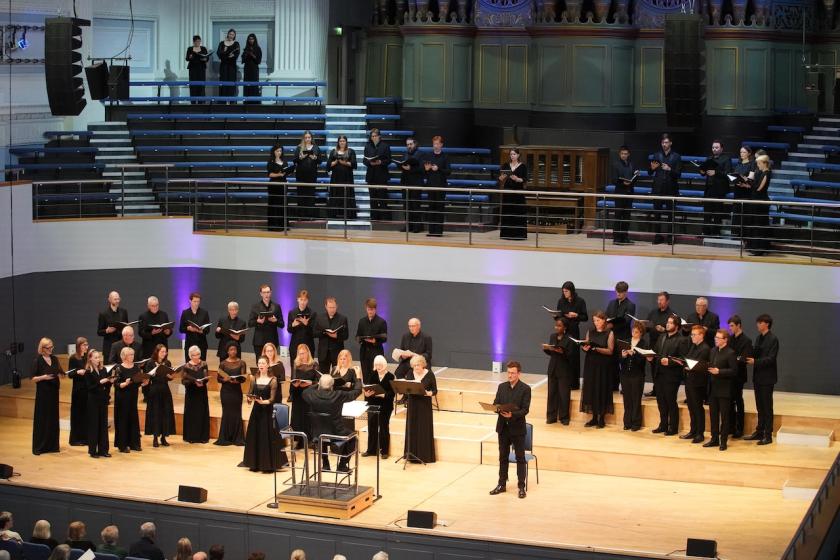
All hail to the 40-part motet, which set up the structure for one of the most exhilarating, sonically dynamic concerts I’ve heard this year. The Birmingham-based Ex Cathedra, one of our most shrewdly innovative chamber choirs, performed a Tallis-inspired programme in which the works of the 16th century genius framed two of their commissions, the brand new The Wilderness by Roderick Williams and the lush-harmonied Earthrise by Alec Roth.
This concert was one of a series marking the final year of Jeffrey Skidmore as the choir’s artistic director, and it felt a fitting way to celebrate his vision and dedication. There are – as with any masterpiece – a number of stories behind how Thomas Tallis’s Spem in Alium came about. The most entertaining, and happily the most credible, is that it was provoked by the competitive spirit of Thomas Howard, Duke of Norfolk, who had heard the Florentine composer Alessandro Striggio’s 40-part Ecce Beatam Lucem, and wanted to prove that the English could do something equally stupendous.
The consensus today is that Tallis, whom he commissioned, produced something that didn’t just match Striggio for size, but exceeded it in quality. Whatever your take, sitting in the eighteenth-century surroundings of St Martin’s-in-the-Fields, it was fascinating to imagine just what impact this monumental work had on its first listeners, as waves of ravishing sound rose and ebbed around the building. The work was structured for eight choirs of five voices, and Skidmore positioned the choirs so that they both encircled the audience on the church floor and looked down from the balconies. Forget today’s technological innovations: this was surround-sound on steroids, in which the complex harmonic interplay between the choirs gradually built up till it felt that we were immersed in the equivalent of a great seascape, swelling and glinting in the sunlight.
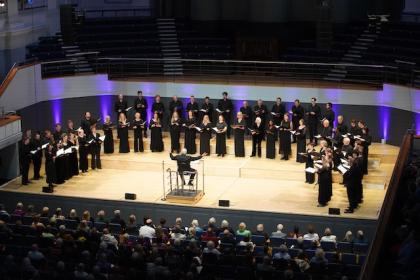
Following this spiritually elevating start, we had a swift palate cleanser of Tallis’s “The Third Tune” before the London premiere of baritone Roderick Williams’ hauntingly beautiful The Wilderness. This was an eloquent reflection on the existence of the homeless, a journey into the shadows and forgotten corners of the city. Williams reconfigured the singers so that they were divided into two ripieno choirs (literally choirs to “pad out” the sound) of eight and twelve, two consorts of five, two trios (three high sopranos and three basses) and four soloists.
Just like many religious compositions, the text is not so much a linear narrative as a series of meditations – here on the margins of urban existence away from the bright lights and the flashy success stories. Williams has created an exquisite fusion of texts in German and English, embracing Wilhelm Müller’s “Gute Nacht” (which previously inspired Schubert) Robert Louis Stevenson’s “Whither Must I Wander”, the Bible’s Matthew “Man does not live on bread alone”, John Gould Fletcher’s “In the City of Night” and the Vagrancy Act, the latter menacingly sung by the three basses.
At the same time as being inspired by the scale of Tallis’s work, Williams revels in being released from the constrictions of the harmonic and rhythmic rules that governed him. Following Daniel Marles’ beautiful opening tenor solo “Fremd bin ich eingezogen” (“A stranger I arrived”) accompanied by sinister sustained chords from the ripieno choirs, a passage dominated by bright looping sopranos introduced the anxiety and anguish of being pushed onto the streets “Home, no more home to me, Hunger my driver, I go where I must”.
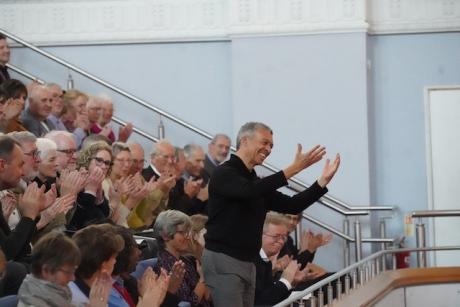
Throughout the work, Williams evoked the sprawling complexity of the city through different vocal textures. When the three high sopranos sang from the balcony, their voices swirled like the cries of seagulls over rubbish dumps, while the basses’ solemn declamation of the Vagrancy Act was a simultaneously amusing and chilling manifestation of police-style pedantry. Skidmore masterfully coordinated the different elements of the choir so that at times they soaringly evoked the glittering mysteries of the city at night while at others their voices clattered and clashed to recreate urban chaos in all its dirt and glory. I was seated behind Williams for the concert (pictured below), and it was fascinating to watch him, alert to the singers’ delivery of each element of his composition, clearly as moved as we all were by the picture they painted of the city at its most ravaged and unknowable.
After the interval, it was time for a very different perspective on the world, as we ascended from the dark alleys of human existence and shot beyond the stratosphere to contemplate the earth from space. Alec Roth was commissioned by Ex Cathedra to create a new work in 2009, the 40th anniversary both of Skidmore’s founding of the choir and of the moon landings. He decided to base his work on the infamous Earthrise image that provoked the wonder of the world and inspired movements including Gaia and Friends of the Earth. His composition falls into three parts: the first looking at “Man’s Drive to Explore and Exploit,” the second a “Contemplation of the Earth Seen from Space”, and the third “A Plea for True Wisdom and Understanding”. Unsurprisingly those messages resonate even more strongly today than they did 17 years ago.
I had not heard any of Roth’s music before, and this was a revelation. Following the solemn chant of the opening antiphon, there was a great vocal swoop upwards as the choir launched into its meditation on humans’ vanity and exploitation of their surroundings (text from Job). Alongside the rich harmonic progressions of this first part, certain of the singers repeated elements of the Latin text so that they sounded like machines bleeping, “quis, quis, quis, ubi.” While this cleverly evoked our technology driven society, the rumble as, at another point, the basses crescendoed into a growl highlighted the sinister undertones of a species powered by technology and unfettered ambition.
Part II began with an unearthly shimmer of voices, taking us into a sonic dimension where we could contemplate our existence from outer space. Ethereal sustained chords shifted into almost hallucinatory harmonic clashes in this evocation of our world, with its text from the Book of Isaiah subtly highlighting the similarities between the Space Age and an era obsessed with a God’s eye perspective. Then we were onto Part III, in which a stirring tenor solo was followed by a collective hum amplified by other voices zigzagging towards a thrilling crescendo; later the interweaving wails of high sopranos echoed those from Williams’ The Wilderness(through presumably the influence was the other way round). Throughout, Roth skilfully spliced together different harmonies and textures to evoke the sensation of terror and awe that inevitably accompanies any meaningful contemplation of existence. The impact was utterly transcendent.
A brief plainchant from Tallis ensued before we were sent out into the streets, energised by the spiritual blast of his Sing and Glorify. On every level – conceptually and musically – this was an extraordinary evening, a monumental testament both to Skidmore’s skill and devotion, and to Tallis’s continued ability to inspire today’s composer to thrillingly lofty heights.