GUIDANCE: When viewing a digital programme during the concert, we request lowering the brightness of your screen to avoid disturbing fellow audience members. Thank you. We kindly request that you do not print this digital programme, printed programmes will be available to buy at the concert.
Ex Cathedra Choir
05 December, Lichfield Cathedral, 7pm
11 December, Coventry Cathedral, 7pm
12 & 15 December, St Martin-in-the-Fields, 7.30pm
17 December, St Mary’s, Moseley, 7pm
19, 22 December, St Paul’s Church, Birmingham 7pm
20 December, St Paul’s Church, Birmingham 4pm
Ex Cathedra Consort
10 December, Hereford Cathedral, 7pm
13 December, St Peter’s Collegiate Church, Wolverhampton, 7pm
16 December, St James the Greater, Leicester, 7pm
Scroll down for “Running order”
Welcome note
There are usually two different Christmas Music by Candlelight programmes, one unaccompanied and sung by the Consort or small Chamber Choir and one for Chamber Choir and organ. It allows me to include a lot of music from the last 56 years of Ex Cathedra’s existence! Much of the repertoire is unique to Ex Cathedra. A seamless sequence of connected music tells the Christmas story and aims to enjoy the architecture and acoustics of our beautiful venues with singing, movement, dance and readings. Strictly Ex Cathedra!
Some pieces are well-known and much loved, an essential part of Christmas tradition – Once in royal David’s city, Away in a manger, Auld lang syne, Silent Night, Ding! dong! merrily on high, See amid the winter’s snow, Sussex Carol, Wexford Carol, and O come, O come Emmanuel.
Some pieces have been written specially for Ex Cathedra. From 1997-2000 as part of the Towards the Millennium celebrations we commissioned six composers to set the Great O Antiphons, ancient texts which announce the Song of Mary on the last seven days of Advent. Roderick Williams wrote two in 1998. We’ve performed the spectacular O Adonaï many times but this is our first performance of O radix Jesse, also written in 1998. Why the wait? In that year there was a Christmas postal strike and the manuscript arrived the day before the first concert, too late to perform this tricky piece which splits into 16 parts to depict the stem of Jesse.
Roderick Williams is a much-loved and multi-talented musician, and is in great demand as one of the UK’s leading baritone singers. He is a graduate of Magdalen College, Oxford. Roddy writes: “The conceit of the piece is best seen on paper; the entire choir begins in unison, singing a motif that aurally recalls the solidity of antique plainsong and visually a stem. Soon afterwards the choir splits into two parts, then three, then four and so on, just as a trunk divides. By the time the piece ends, the scoring has branched into sixteen parts, the texture has given way to intricate ripples of figuration and the initial stem of plainsong has sprouted leaves of notes.” It reminded me of a Bartók fugue. Well worth the 27-year wait! It is wonderful news that the Feeney Trust have generously agreed to fund a 40-part work from Roddy to open our autumn season next year.
There are 13 pieces in tonight’s programme by living composers and many have become classics – In the stillness (Sally Beamish), Gentle flame and For this babe (Liz Dilnot Johnson), And lo, the angel of the Lord (James MacMillan), Sol justitiae (Alec Roth), and The Long Road (Ēriks Eŝenvalds).
As ever there are pieces new to Candlelight and by local composers – Darkness into Light (Rupert Jeffcoat, our virtuosic organist and repetiteur), Nesciens mater (Christopher Churcher, formerly a member of the Academy of Vocal Music and now an undergraduate musician at Lady Margaret Hall, Oxford) and Winter’s Hymn (Ruairi Edwards, one of the extraordinary, charismatic members of the Education & Participation team).
There are anniversaries to celebrate. I have avoided the more obvious. Much as I love Arvo Pärt and John Rutter they are well represented elsewhere. I have chosen two works by Jacobean composer Orlando Gibbons (Thus angels sung and Hosanna to the Son of David), a little known setting of Hark! the herald angels sing, thought to be by Shrewsbury-born Charles Burney, and as a tribute to King James 1, self-styled King of Great Britain, I have included works from England (take your pick), Wales (William Mathias, Ruairi Edwards), Scotland (James MacMillan) and Ireland (Seán Doherty).
Deciding what to leave out is always hard and some real favourites have to be reserved for another year. I think there are more differences between programmes this year, allowing more music and hoping to satisfy some of our most ardent supporters who like to come to both.
There is always room for some stocking-fillers. The angelic Alleluia, a snippet from the end of Berlioz’s Flight from Egypt from L’Enfance du Christ was an irresistible inclusion. The Branle de l’Official (Orchésographie 1589 – aka Ding! Dong!) by Jehan Tabouret, which enables the choir to dance the slightly raunchy 16th century dance down the nave and aisles of the venues is an essential bit of fun. And the exquisitely simple Still, still, still conjures up the seasonal, snowy landscape of the Austrian Alps.
There are powerful, passionate readings from George Herbert’s The Temple (1633), the King James Bible (1611), Robert Southwell’s clever call to arms New Heaven, New War, and Ben Okri’s inspirational Mental Fight (1999). Gervase Phinn’s hilarious The Other Side of the Dale (1998) provides some humour. The brilliant and intriguing British poet Ayodeji Malcom Guite was introduced to me by Shirley Scott (a BBC Producer and soprano with Ex Cathedra for almost 40 years). He describes himself as “a poet, priest and rock and roller in any order you like, really. I’m the same person in all three”. The two beautiful sonnets, O Radix and O Emmanuel from his Sounding the seasons was published in 2012. He was born in Nigeria, his father was a Methodist Preacher, and subsequently he lived in Canada and the UK. He has degrees from Durham and Cambridge, where he now lives. He plays in a rock band.
The year in which we perform Bach’s six cantatas The Christmas Oratorio is always special. We are reminded just what a great account of the Christmas story this is and also how much Bach has influenced our lives and music making. Liz Dilnot Johnson’s Gentle flame is taken from her cantata I stand at the door, Noël nouvelet! from Alec Roth’s recently premiered completion and revision of the 2019 Cantata A time to be born – all inspired by Bach.
Every year from the very beginning in 1969 the Candlelight programme has ended with the famous chorale How shall I fitly meet thee? from the opening cantata of Bach’s majestic masterpiece, in John Troutbeck’s matchless translation.
How will you receive the special gift of a child this Christmas?
Running order
(Hereford, Leicester, Wolverhampton)
Alleluya (from L’Enfance du Christ) – Hector Berlioz (1803-1869)
Once in Royal David’s City (v.1) – HJ Gauntlett/C F Alexander (1804-1876/1818-1895)
O Adonai – Marc-Antoine Charpentier (1643-1704)
O Adonai – Roderick Williams (b.1965)
Gentle flame – Liz Dilnot Johnson (b.1964)
Hodie Christus natus est – Plainchant
Hymn to the Virgin – Benjamin Britten (1913-1976)
Bethlehem down – Peter Warlock (1894-1930)
My Lord has come – Will Todd (b.1970)
Reading: The Call – George Herbert (1593-1633)
Nesciens mater – Christopher Churcher (b.2004)
Away in a manger – WJ Kirkpatrick (1838-1921) arr. Willcocks
Still, still, still – Salzburg arr. Jeffrey Skidmore
Reading: Teach us – Gervase Phinn (b.1946)
Auld lang syne – Scottish Melody after Haydn arr. Jeffrey Skidmore
Tourdion – Pierre Attaingnant (1494-1552)/César Geoffray (1901-1972)
Los coflades – ¡Ay andar! – Juan de Araujo (1646-1712)
INTERVAL
Winter’s Hymn – Ruairi Edwards (b.1988)
A Nywe Werk – Seán Doherty (b.1987)
Wexford Carol – Irish Traditional
Reading: And it came to pass Luke ii 1 – 14
Branle de l’Official – Jehan Tabouret (1520-1595) arr Jeffrey Skidmore
Thus angels sung – Orlando Gibbons (1583-1625) completed Jeffrey Skidmore
Hosanna to the Son of David – Orlando Gibbons
Reading: O Radix Jesse – Macolm Guite (b.1957)
Es is ein Ros entsprungen – Michael Praetorius (1571-1621)
Sol justitiae – Alec Roth (b.1948)
In the stillness – Sally Beamish (b.1956)
Reading: New heaven, new war – Robert Southwell (1561-1595)
For this babe – Liz Dilnot Johnson
African Crib Carol – F. Roy Bennett arr. Jeffrey Skidmore
Reading: Our future is greater than our past – Ben Okri (b.1959)
Noël c’est la Joie – Naji Hakim (b.1955)
Noël nouvelet – French traditional
The Long Road – Ēriks Eŝenvalds (b.1977)
Reading: O Emmanuel – Malcolm Guite
How shall I fitly meet thee? – J S Bach (1685-1750)
O come, O come, Emmanuel! (vv1, 3 and 5) – 13th century French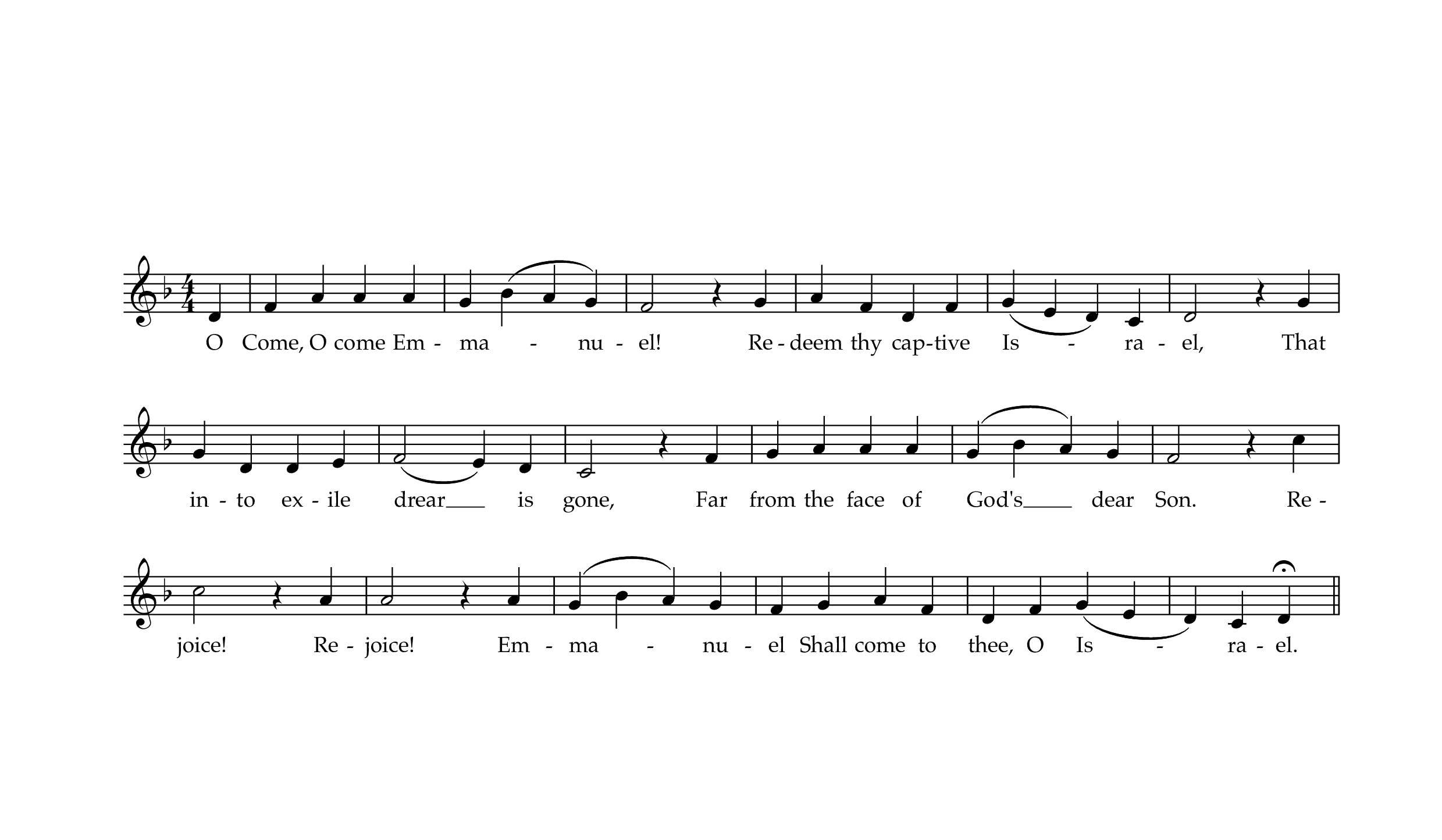
1. O come, O come, Emmanuel
Redeem thy captive Israel
That into exile drear is gone,
Far from the face of God’s dear Son.
Rejoice! Rejoice! Emmanuel
Shall come to thee, O Israel.
3. O come, O come, thou Dayspring bright!
Pour on our souls thy healing light;
Dispel the long night’s lingering gloom,
And pierce the shadows of the tomb.
Rejoice! Rejoice…
5. O come, O come, Adonai,
Who in thy glorious majesty
From that high mountain clothed in awe,
Gavest thy folk the elder Law.
Rejoice! Rejoice…
(Lichfield, Coventry, Moseley, London, Birmingham)
Alleluya (from L’Enfance du Christ) – Hector Berlioz (1803-1869)
Once in Royal David’s City (v.1) – HJ Gauntlett/C F Alexander (1804-1876/1818-1895)
O Adonai – Roderick Williams (b.1965)
Gentle flame – Liz Dilnot Johnson (b.1964)
Hodie Christus natus est – Antiphon for Christmas Day
Hymn to the Virgin – Benjamin Britten (1913-1976)
Sussex Carol – English Traditional
My Lord has come – Will Todd (b.1970)
I wonder as I wander – Carl Rütti (b.1949)
Bethlehem down – Peter Warlock (1984-1930)
Reading: The Call – George Herbert (1593-1633)
Nesciens mater – Christopher Churcher (b.2004)
Hark! the herald angels sing – Charles Burney (1726-1814)
Away in a manger – WJ Kirkpatrick (1838-1921) arr. Willcocks
Still, still, still – Salzburg arr. Jeffrey Skidmore
Reading: Teach us – Gervase Phinn (b.1946)
Auld lang syne – Scottish Melody after Haydn arr .Jeffrey Skidmore
Tourdion – Pierre Attaingnant/César Geoffray (149-1522/1901-1972)
Sir Christèmas – William Mathias (1934-1992)
INTERVAL
Alleluya – Hector Berlioz
Es is ein Ros entsprungen – Michael Praetorius
O Radix Jesse – Roderick Williams
Darkness into light – Rupert Jeffcoat (b.1970)
Stille Nacht – Franz Gruber (1787-1863) arr. Jeffrey Skidmore
Torches – John Joubert (1927-2019)
Reading: And it came to pass – Luke ii 1 – 8 (King James 1611)
And lo, the angel of the Lord – James MacMillan (b.1959)
Branle de l’Official – Jehan Tabouret (1520-1595) arr. Jeffrey Skidmore
Thus angels sung – Orlando Gibbons (1583-1625) completed Jeffrey Skidmore
Reading: Our future is greater than our past – Ben Okri (b.1959)
In the stillness – Sally Beamish (b.1956)
Noël c’est la Joie – Naji Hakim (b.1955)
The Long Road – Ēriks Eŝenvalds (b.1977)
Noël nouvelet – French traditional
Reading: O Emmanuel – Malcolm Guite (b.1957)
How shall I fitly meet thee? – J S Bach (1685-1750)
Organ improvisation
See amid the winter’s snow – John Goss (1800-1880)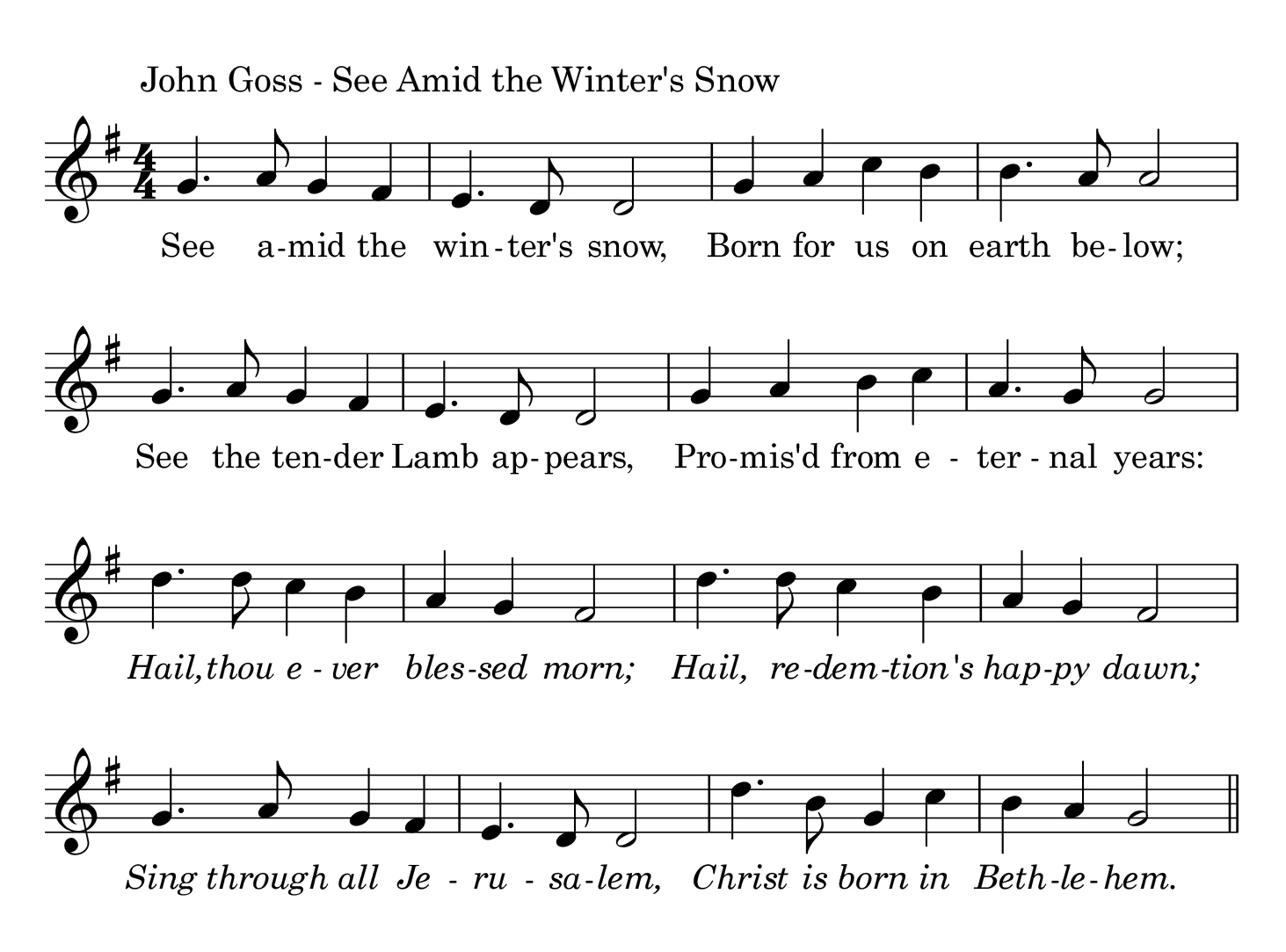
1: (Audience and choir)
See amid the winter’s snow,
Born for us on earth below;
See the tender lamb appears,
Promised from eternal years.
Hail, thou ever blessed morn;
Hail, redemption’s happy dawn;
Sing through all Jerusalem,
Christ is born in Bethlehem.
2: (Audience and choir upper voices)
Say, ye holy shepherds, say
What your joyful news today;
Wherefore have ye left your sheep
On the lonely mountain steep.
Hail, thou ever blessed morn…
3: (Audience and choir lower voices)
As we watch’d at dead of night,
Lo, we saw a wondrous light;
Angels singing, “Peace on earth”
Told us of the Saviour’s birth.
Hail, thou ever blessed morn…
4: (Audience only)
Sacred infant, all divine,
What a tender love was thine,
Thus to come from highest bliss
Down to such a world as this.
Hail, thou ever blessed morn…
5: (Audience and choir)
Teach, O teach us, Holy child,
By thy face so meek and mild,
Teach us to resemble thee,
In thy sweet humility:
Hail, thou ever blessed morn…
Programme Note
The programme continues with the usual flow of music and readings from 13th century plainchant O come, O come Emmanuel to the premiere of a new work Ring out wild bells by our composer-in-residence Liz Dilnot Johnson. She writes: In the ten-part Ring Out Wild Bells, setting words by Tennyson, the choir ‘rings out the old’ and ‘rings in the new’, chiming out a vision of hope, ending with each singer moving around the audience to ‘Ring in a thousand years of peace’.
There is also a new edition of the Coventry Carol created as part of the AHRC Aural Histories project which is led by Professor Jamie Savan, Director of Research at the Royal Birmingham Conservatoire. He writes:
The famous ‘Coventry Carol’ from the Taylors and Shearmen’s Pageant is one of only two songs to survive from the great sequence of mystery plays performed by the various trade and craft companies of Coventry from the later Middle Ages until the latter part of the sixteenth century. Many of the important primary sources relating to these plays were destroyed in the great fire at Birmingham Central Library in 1879, but we owe the survival of this carol to the antiquarian Thomas Sharp, who included a transcription of it in his Dissertation on the Pageants or Dramatic Mysteries Anciently Performed at Coventry, published in 1825.
Unfortunately, Sharp was no musician, and consequently his transcription contains numerous errors and ambiguities which require editorial correction, sometimes leading to quite different interpretations of the piece. The more familiar modern editions of the carol are in triple meter, but Sharp’s transcription is quite clearly in duple time which we have retained in this version, creating a rhythmic counterpoint with the natural accentuations of the text.
There are ‘carols’ from the last 50 years by the contemporary greats – John Tavener, Judith Weir, James MacMillan, Benjamin Britten and the new generation – Ēriks Ešenvalds and Will Todd – who have contributed some well-loved classics. In his anniversary year Arnold Schoenberg, who some people regard as the enfant terrible of the early 20th century also finds a place with the final, stunning climax of his wonderful motet Friede auf Erde (Peace on Earth). Local, distinguished composers have a rightful place with works by John Joubert, Martin Bates, Liz Dilnot Johnson and Alec Roth. And we should remember the Birmingham Oratorian priest John Caswell who wrote the words of See amid the winter’s snow.
The British regions are well represented by traditional songs, and John Gould’s exquisite setting of the Sans Day Carol, much loved by the choir and I think now unique to Ex Cathedra. There are pieces from Sussex, Cornwall, Coventry (Warkickshire), Scotland (Ayrshire), Somerset and Yorkshire. International songs have their place with works from Spain, France, Germany, Sweden, Finland, Czech Republic and the USA. And there is an important contribution from female composers and authors – Gwen Blandford, Christina Rossetti, Judith Weir and Liz Dilnot Johnson. Liz’s new CD Gentle Flame is receiving great reviews and one critic (Planet Hugill) spoke of the title track as ‘a gentle piece where multiple diverse lines coalesce into something special.’
We make use of the building with ‘choreography’ and dancing; there are drinking songs, love songs and lullabies, with a splash of humour in the readings by Gervaise Phinn and Kenneth Grahame, contrasting with the poignancy of the Laurie Lee, the Christina Rossetti and the Henry Vaughan. Although there is quite a diversity of material the message remains the same: joy, peace, love and a call for justice – all in the space of two short halves! Happy Christmas!
Performers
EX CATHEDRA
Jeffrey Skidmore conductor
Nick Wearne & Rupert Jeffcoat, organ

Lichfield, 05 December
Nicholas Wearne, organ

Soprano: Marianne Ayling, Alexandra Burstow**, Evelyn Byford**, Lizzie Drury, Sophie Henderson**, Margaret Langford, Margaret Lingas, Alice Madden***, Hannah Rowe, Imogen Russell, Shirley Scott, Katie Trethewey
Alto: Sarah Colgan, Gabriella Liandu, Lucy Ormrod*, Katy Raines-Rami, Ellie Stamp, Laura Toomey**
Tenor: Nick Drew, Tom Hawkey-Soar***, Sid Imanol, Dan Marles*,  Andrew Morton*, James Wells
Bass: Oliver Barker, Jeremy Burrows, John Cotterill, Richard Green, Matt Pandya*, Lucas Rebato***, Barney Stevens, William Swinnerton**, Josh Thompson**, Lawrence White

Hereford, 10 December

Soprano: Caroline Halls, Margaret Lingas, Imogen Russell, Suzzie Vango
Alto: Ellie Stamp, Laura Toomey
Tenor: Sid Imanol, James Robinson
Bass: Simon Gallear, Lawrence White

Coventry, 11 December
Rupert Jeffcoat, organ

Soprano: Marianne Ayling, Caroline Halls, Margaret Lingas, Alice Madden***, Imogen Russell, Shirley Scott, Suzzie Vango
Alto: Sarah Colgan, Georgi Davies**, Steph Garrett, Hannah Komedera***, Lucy Ormrod*, Katy Raines-Rami, Laura Toomey**
Tenor: Steve Davis, Nick Drew, Tom Hawkey-Soar**, Sid Imanol, Dan Marles*, Andrew Morton*, Toby Ward
Bass: Jeremy Burrows, Christopher Churcher, John Cotterill, Simon Gallear, Richard Green, John Johnston, Matt Pandya*, Barney Stevens

St Martin-in-the-Fields (12 December, 15 December)
Rupert Jeffcoat, organ

Soprano: Marianne Ayling, Phoebe Boateng, Alexandra Burstow**, Evelyn Byford**, Lizzie Drury, Caroline Halls, Sophie Henderson**, Margaret Lingas, Alice Madden***, Hannah Rowe, Imogen Russell, Sally Spencer, Suzzie Vango
Alto: Sarah Colgan, Georgi Davies**, Hannah Komedera, Suzie Purkis, Katy Raines-Rami, Andrew Round, Ellie Stamp, Laura Toomey**
Tenor: Isaac Boulter, Steve Davis, Tom Hawkey-Soar**, Dan Marles*, Andrew Morton*, James Robinson, Toby Ward, James Wells
Bass: Oliver Barker, Jeremy Burrows, Christopher Churcher, John Cotterill, Ryan Evans***, Simon Gallear, Richard Green, Lucas Rebato***, Barney Stevens, William Swinnerton**, Josh Thompson**, Lawrence White

Wolverhampton, 13 December

Soprano: Caroline Halls, Margaret Lingas, Imogen Russell, Katie Trethewey
Alto: Suzie Purkis, Laura Toomey
Tenor: Declan Costello, Sid Imanol
Bass: Oliver Barker, John Johnston

Leicester, 16 December

Soprano: Lizzie Drury, Margaret Lingas, Imogen Russell, Suzzie Vango
Alto: Suzie Purkis, Ellie Stamp
Tenor: Sid Imanol, James Wells
Bass: Simon Gallear, Lawrence White

Moseley, 17 December
Rupert Jeffcoat, organ

Soprano: Marianne Ayling, Alexandra Burstow**, Evelyn Byford**, Lizzie Drury, Sophie Henderson**, Joy Krishnamoorthy, Rebecca Ledgard, Alice Madden***, Imogen Russell, Shirley Scott, Sally Spencer, Suzzie Vango
Alto: Georgi Davies, Lucy Ormrod, Suzie Purkis, Katy Raines-Rami, Ellie Stamp, Laura Toomey **
Tenor: Steve Davis, Nick Drew, Tom Hawkey-Soar**, Sid Imanol, Dan Marles*, Andrew Morton*
Bass: Ryan Evans, Simon Gallear, Richard Green, Matt Pandya*, Barney Stevens, William Swinnerton**, Josh Thompson**, Lawrence White

St Paul’s Birmingham (19, 20, 22 December)
Nicholas Wearne, organ

Soprano: Marianne Ayling, Phoebe Boateng, Alexandra Burstow**, Evelyn Byford**, Ros Crouch, Caroline Halls, Sophie Henderson**, Joy Krishnamoorthy, Margaret Langford, Rebecca Ledgard, Margaret Lingas, Alice Madden***, Hannah Rowe, Imogen Russell, Shirley Scott, Sally Spencer, Katie Trethewey, Suzzie Vango
Alto: Sarah Colgan, Georgi Davies, Steph Garrett, Lucy Ormrod*, Katy Raines-Rami, Laura Toomey**
Tenor: Isaac Boulter, Steve Davis, Nick Drew, Tom Hawkey-Soar**, Dan Marles, Andrew Morton*, James Robinson, Toby Ward
Bass: Christopher Churcher, John Cotterill, Ryan Evans***, Richard Green, John Johnston, Matt Pandya*, Lucas Rebato***, David Smith, Barney Stevens, William Swinnerton**, Josh Thompson**, Lawrence White

* denotes Ex Cathedra Graduate Scholar
** denotes Student Scholar studying at Royal Birmingham Conservatoire
*** denotes Student Scholar studying at University of Birmingham
Follow us on social media!
Facebook: facebook.com/excathedra
Instagram: instagram.com/excathedra_choir or @excathedra_choir
X: x.com/excathedrachoir or @excathedrachoir
Meet the… musician
In this programme, we invite you to meet Nick Drew.
Be an Angel…
We believe everyone should have the opportunity to access extraordinary choral music and feel the wonderful benefits of singing, which is why we share our love of singing with as many people as possible through concerts, new commissions, recordings, training choirs for young singers, Scholarships, and community projects that reach 90,000 children and adults every year.
Your support is vital in helping us achieve our charitable mission to share great choral music with as many people as possible.
Our work is only possible thanks to the generous support of the many people listed in our Host of Angels. I should be delighted and enormously grateful if you would consider joining them and becoming a valued member of supporter programme – be an Angel and give the gift of singing today. Find out how by following this link.