


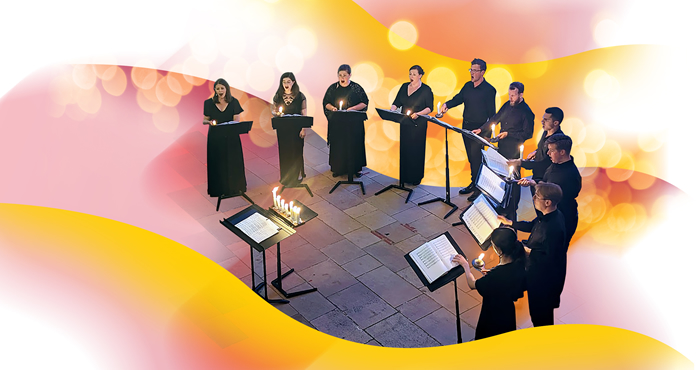
GUIDANCE: When viewing a digital programme during the concert, we request lowering the brightness of your screen to avoid disturbing fellow audience members. Thank you. We kindly request that you do not print this digital programme, printed programmes will be available to buy at the concert.
EC CATHEDRA Consort
12 June, Hereford Cathedral, 8pm
13 June, St Peter’s Collegiate Church, Wolverhampton, 8pm
25 June, St Martin-in-the-Fields, London, 8pm
EX CATHEDRA Choir
18 June, St Paul’s Church, Birmingham 8pm

Running order:
Hymnus Eucharisticus – Benjamin Rogers (1614-1698), Latin text attributed to Dr Nathaniel Ingelo
Iam lucis orto sidere – 6th Century Plainchant
The Windhover – Liz Dilnot Johnson (b.1964)
Sumer is icumen in – 13th Century English
Cuckoo! – Benjamin Britten (1913-1976) arr. Jeffrey Skidmore, text: Jane Taylor (1783-1824)
Le chant des oyseaulx – Clément Janequin (1485-1558)
Reading: Caged Bird – Maya Angelou (1928-2014)
The Silver Swanne – Orlando Gibbons (1583-1625)
and the swallow – Caroline Shaw (b.1982)
The Bluebird – Charles Villiers Stanford (1852-1924)
Reading: Another reason I don’t keep a gun in the house – Billy Collins (b.1941)
Mostly Mozart – arr. Jeffrey Skidmore
Reading: Summer – Amy Lowell (1874-1925)
Summertime – George Gershwin (1898-1937) arr, Jeffrey Skidmore
La mer – Charles Trenet (1913-2001) arr. Jeffrey Skidmore
Summer Holiday – Bruce Welch (b.1941) & Brian Bennett (b.1940) arr. Jeffrey Skidmore
INTERVAL – 20 minutes
Times and Seasons – Alec Roth (b.1948), Ecclesiastes 3: 1-3, 5-8, 4, King Solomon (attrib.) – translation: King James Version 1611
This have I done for my true love – Gustav Holst (1874-1934)
Reading: The owl and the pussycat – Edward Lear (1812-1888)
Dance to your daddy – Northumberland arr. Ian Humphries
Singin’ in the Rain – Arthur Freed (1894-1973) & Nacio Herb Brown (1896-1964) arr. Jeffrey Skidmore
Reading: Jabberwocky – Lewis Carroll (1832-1898)
Trois Chansons – Maurice Ravel (1875-1937)
I Nicolette
II Trois beaux oiseaux du Paradis
III Ronde
Reading: The British – Benjamin Zephaniah (1958-2023)
And did those feet – Charles Hubert Parry (1848-1918) arr. Jeffrey Skidmore, text William Blake
Blake Reimagined – Liz Dilnot Johnson
Reading: Anne Hathaway – Carol Ann Duffy (b.1955)
For all we know – Fred Karlin (1936-2004), Robb Royer (b.1942), & Jimmy Griffin (1943-2005) arr. Jeffrey Skidmore
Who do you think you are kidding, Mr Hitler? – Jimmy Perry (1923-2016), & Derek Taverner, arr. Jeffrey Skidmore
Reading: It’s time, my friend, it’s time – Alexander Pushkin (1799-1837), translated – Michael Pushkin
Peace I leave with you – Amy Beach (1867-1944)
Te lucis ante terminum – 7th Century Plainchant
Night Prayer – Alec Roth, English translation: J.M. Neale (1818-1866)
Scroll down for texts and translations

Programme Note
The concert begins as ever with the Tower Hymn or Hymnus Eucharisticus, traditionally sung on Oxford’s Magdalen College Tower at 6:00 am, sunrise, on May Morning. It is in fact a Latin hymn composed by Benjamin Rogers who for some years was Informator Choristarum at Magdalen. It may have been composed for the celebration of the Restoration of the monarchy in 1660. To this day it is often performed as a Grace in the college at special meals. The story goes that one rainy May Morning, nobody knows exactly when, one of the few pieces the choir could sing from memory was the Grace. And so the tradition began! Iam lucis orto sidereis the one and only hymn prescribed for use at Prime in the Divine Office. It is the first office of the new day performed at daylight at approximately 6:00 am.
The Windhover was commissioned by Ex Cathedra in 2020, the fifth of our series of Dawn Chorus commissions. It received its premiere a year later than planned! It is a wonderful setting of Jesuit priest Gerard Manley Hopkins’ passionate sonnet about a bird, love and with an intriguing dedication To Christ our Lord.
Liz Dilnot Johnson writes: Setting the words of this poem has been a true adventure for me. A muscular bass solo threads through the music, into which wild kestrel calls and the sound of wind through feathers are woven, leading to a climax at the lines ‘the fire that breaks from thee then… O my chevalier!’ The opening sequence of chords with their shifting harmonies aims to evoke that magical moment of stillness just before sunrise.
Sumer is icumen in is amongst the earliest known polyphony. It was probably composed shortly after the Magna Carta was signed over 800 years ago in 1215. A manuscript found in Reading Abbey dates from the mid-13th century. Sometimes referred to as the Summer Canon, the Reading Rota or the Cuckoo Song, this ingenious work has a canonic ground bass and a melody which can be sung as a round in 12 parts! Cuckoo! by Benjamin Britten takes up the distinctive birdcall. This exquisite miniature is taken from Friday Afternoons, a set of songs written in 1936 for the choir of his brother’s boys’ school in Prestatyn, North Wales. On a recent visit to this beautiful area I heard my first cuckoo of the year and saw my first swallow. Summer had arrived.
Janequin’s chansons are early, Renaissance examples of programme music which tell a story through onomatopoeic vocalisations. Le chant des oiseaulx celebrates birdsong; listen out for the king thrush, the blackbird, the starling, nightingale and cuckoo.
The phenomenal American poet Maya Angelou’s Caged bird continues the ornithological theme but with clear political undertones. There is a strange synergy with the anonymous and gently resentful text of Gibbons’ famous madrigal The Silver Swanne published in 1612, a time of political and musical change and unrest. ‘More geese than swans now live more fools than wise’ – I wonder what the 21st century version of that might be …
American composer Caroline Shaw is a Grammy Award winner and was the youngest recipient of the Pulitzer Prize for Music. and the swallow, a setting of Psalm 84 was written in 2017 and premiered by the Netherlands Chamber Choir. Shaw spoke of how she was thinking of the Syrian refugee crisis as she composed the work: ‘There’s a yearning for a home that feels very relevant today. The second verse is: “The sparrow found a house and the swallow her nest, where she may place her young” which is just a beautiful image of a bird trying to keep her children safe, people trying to keep their family safe.’ The Bluebird, perhaps Stanford’s most popular part-song was written in 1910 and effortlessly captures the serenity of the bird’s flight across the lake in Mary Coleridge’s mystical poem.
Billy Collins is a New Yorker whose poetry has gained him many honours. His poem Another reason I don’t keep a gun in the house made me laugh out loud when I first read it. Mostly Mozart! continues the light-hearted mood. It is a ‘didactic’ work suitable perhaps for a summer school. We gave it a whirl, with some success, at Dartington International Summer School. It is a medley of well-known tunes arranged in a sonata structure – introduction (Eine kleine Nachtmusik), first subject (Piano Sonata in C), second subject (Clarinet Quintet), transition (Queen of the Night), development (Horn Concerto in Eb) and coda (Symphonies 40 but mostly 41). Notice also the subdominant recapitulation! It owes much to the Swingle Singers in their early years.
New England poet Amy Lowell published Summer in A Dome of Many-Coloured Glass in 1912 and while praising the beauty of all the seasons establishes the ‘glorious, deep-toned summer as the very crown of the changing year’. It introduces a group of popular songs, several of which were arranged for the school choirs that I worked with over the years. They have proved popular for summer events and parties. Summertime from George Gershwin’s opera Porgy and Bess (1935) is one of the most famous songs of all time. Edwin DuBose Heyward’s idyllic imagery effortlessly conjures up the perfect summer of relaxation, a time of contentment, dreaming of blue sky and sea. The singer song-writer Charles Trenet was born in Narbonne in 1913 and wrote the words for the chanson classique La Mer in 1929 on a train journey from Montpellier to Perpignan while gazing at the Étang du Thau, a beautiful coastal lagoon west of Sète on the Mediterranean in the South of France. I know it well! The music came to him some years later in 1943. Summer Holiday was written by Bruce Welsh and Brian Bennet who were members of the Shadows. This number one hit featured in the popular Cliff Richard film in 1963.
Alec Roth’s music has been described as ‘traditional yet ground-breaking and whilst refusing to duck the thornier issues that confront us, seems calculated to make us glad to be alive’. What more can we ask of art in the 21st century? His music is becoming increasingly popular around the world and I have recently returned from the German premiere of his latest work – Honig aller Wesen (Honey of all beings) – commissioned and performed by Berlin’s famous RIAS Kammerchor for the 75th anniversary of their foundation in 1948. I can’t wait to give a performance in the UK!
Alec has a special feeling for words, empathy for the voice, delicate harmonic sense, and seemingly effortless technique and skill. He is so much part of our work now it is unimaginable not to include some works by him in this programme. Times and Seasons, setting words from Ecclesiastes, is the opening procession from A Time to Dance, a cantata based on the four seasons, which Alec Roth wrote for Ex Cathedra and the Sherborne Summer Festival in 2012.
It is not surprising that one of Alec’s favourite pieces is Holst’s choral masterpiece, the great Cornish dance This have I done for my true love Op 34, no 1 (H128). Written in 1916 (the manuscript is signed St Paul’s Girls School, Brook Green W6), it is one of his greatest part-songs and is a suitable tribute in the 150th anniversary year of his birth.
Edward Lear’s The Owl and the Pussycat is a perfect example of nonsense poetry with subversive elements. ‘Dancing by the light of the moon’ continues the dance theme.
Dance to your daddy is probably one of the best-known traditional Geordie folk songs, made even more famous by the popular First World War TV series When the boat comes in. Ex Cathedra sang this skilful arrangement by Ian Humphries when we won the BBC choral completion Let the Peoples Sing in 1980. No English summer is complete without rain! The love song Singin’ in the Rain by Arthur Freed and Herb Brown was published in 1929 and made famous in the 1952 Hollywood film featuring the legendary Gene Kelly dance sequence. We have sung it at many soggy garden parties and outdoor events!
Lewis Carrol’s Jabberwocky is a whimsical, mock-heroic nonsense poem taken from his novel Alice through the looking glass written in 1871, the same year as the Lear poem! It makes a suitable introduction to Ravel’s fanciful three chansons.
Maurice Ravel was a great patriot and wanted desperately to fight for his country in the First World War. He was most distressed that he was not able to do so, and the war years produced little music apart from Trois Chansons. The texts are by Ravel himself and are superb pastiche. Nicolette (a French version of Little Red Riding Hood) and Ronde (Teddy Bear’s Picnic), while containing a certain amount of humour, also reveal a cynicism which reflects the times. Ronde in particular makes considerable demands on the singers with its sparkling word-play, typical of this genre. The middle song – Trois beaux oiseaux du Paradis – is more serious in nature and while it may allude to Ravel’s desire to participate in the Great War, this heart-rending setting demands a wider interpretation. The three songs were written in 1914 and 1915 and published in 1916. They were first performed in 1917. The dedications are also of some interest featuring Tristan Klingsor, Paul Painlevé and Mme Paul Clemenceau respectively.
Benjamin Zephaniah is a born-and-bred Brummie with Barbadian parents. He died last December aged 65. His extraordinary life created some extraordinary poetry. The British is a recipe for our nation and was published in Wicked World in 2003. There is a footnote to the poem.
Note: All the ingredients are equally
important. Treating one ingredient better than another will leave a bitter
unpleasant taste.
Warning: An unequal spread of justice will damage the people
and cause pain. Give justice and equality to all.
Parry’s And did those feet is here arranged, for the first time I think, for unaccompanied choir, and the two verses are placed either side of Liz Dilnot Johnson’s Blake Re-imagined. In 1916 Parry was commissioned to set to music Blake’s idealistic, visionary poem And did those feet in ancient time. Now widely used and familiar as the patriotic hymn Jerusalem, this is an opportunity for us to reclaim it as a stirring piece of music set to a text by one of our greatest metaphysical poets. A hundred years later Blake Reimagined is a rallying call to action to rebuild a better world. It was commissioned in the middle of the pandemic from Malvern-based composer Liz Dilnot Johnson, who is another Ex Cathedra composer-in-residence. This inspirational piece with its fusion of English and jazz improvisation, makes use of Parry’s hymn Jerusalem, with its stirring, romantic harmonies, full of longing, and with snatches of the famously uplifting melody never far away. It was written in the summer of 2020 by Liz Dilnot Johnson for our anniversary virtual video – Ex Cathedra: Our first 50 years – partly in response to the challenge that it was not possible for a composer to set Blake’s visionary words And did those feet because Parry’s setting was so definitive. She responded with this new piece which many have referred to as a work of genius reimagining Parry’s harmonies and Blake’s words for two contrasting choirs. One choir improvises short supplicatory phrases – ‘bring me’, ‘I will’, ‘till we have built ….’ while the other choir responds with gospel-like chords but following Parry’s harmonies. Both choirs sing together, still with the freedom of aleatoric improvisation, the phrase ‘till we have built …. in England’s green and pleasant land’ ending with a solo tenor calling twice the words ‘bring me….’. You are invited to sing Parry’s second verse with all the passion you can muster. The phrase ‘arrows of desire’ in this arrangement references Elgar’s orchestrated version written for the Leeds Festival 100 years ago in 1922.
Shakespeare writes in his will: ‘Item I gyve my wife my second best bed’. It is sometimes thought that the gift was an insult but of course the opposite is true, a sensuous reminder of their love-making, which former Poet Laureate Carol Ann Duffy makes beautifully clear in her love sonnet Anne Hathaway about the unique delights of the marital bed. For all we know is a choral arrangement of American pop duo the Carpenters’ famous love-song from the early 70s which won an Academy Award for the Best Original Song. It was one of many arrangements Ex Cathedra sang in bars and pubs on their legendary trips abroad in the 70s and 80s. The good old days! Who do you think you are kidding, Mr Hitler? is a tribute to Ian Lavender – Pike – in the famous television cult comedy classic series Dad’s Army. Ian was a Brummie and as Head Boy at Bournville School was my hero from the distance of Year 7!
Alexander Pushkin’s poem It’s time, my friend, it’s time was suggested to me by my good friend and colleague at Royal Birmingham Conservatoire, Michael Pushkin, during a lunch-time conversation about succession and retirement! It’s read here in Michael’s own metrical and rhymed translation.
Пора, мой друг, пора! Покоя сердце просит –Летят за днями дни, и каждый час уносит
Частичку бытия, а мы с тобой вдвоём
Предпологаем жить . . . И глядь – как раз – умрём.
На свете счастья нет, но есть покой и воля.
Давно завидная мечтается мне доля –
Давно, усталый раб, замыслил я побег
В обитель дальную трудов и чистых нег.
As evening draws on we look to the quiet and calm of the night for rest and relaxation. Amy Beach’s serene setting of the biblical text Peace I leave with you (John 14: 27) is the third of three Choral Responses op 8 published in 1891. The ancient Latin hymn Te lucis ante terminum which dates back to the 7th century is a prayer for the end of the day and is the hymn sung at Compline. Night Prayer is Alec Roth’s typically atmospheric setting of this wonderful English melody.

Performers
EX CATHEDRA
Jeffrey Skidmore conductor
HEREFORD (12 June)
Soprano: Margaret Lingas, Imogen Russell, Katie Trethewey, Suzzie Vango
Alto: Sam Mitchell, Suzie Purkis
Tenor: Sid Imanol, James Wells
Bass: Simon Gallear, Lawrence White
WOLVERHAMPTON (13 June)
Soprano: Margaret Lingas, Imogen Russell, Katie Trethewey, Suzzie Vango
Alto: Sam Mitchell, Suzie Purkis
Tenor: Sid Imanol, Daniel Marles
Bass: Tom Lowen, Lawrence White
BIRMINGHAM ST PAUL’S (18 June)
Soprano: Marianne Ayling, Phoebe Boateng, Alison Burnett, Ros Crouch, Naomi Hedges, Joy Krishnamoorthy, Margaret Langford, Margaret Lingas, Rebecca Mills, Hannah Rowe+, Imogen Russell, Shirley Scott, Rachel Snape, Katie Trethewey, Clover Willis**
Alto: Molly Fry+, Martin Hodgkinson, Suzie Purkis, Katy Raines-Rami, Anna Semple, Ellie Stamp**
Tenor: Monty Charles+, Steve Davis, Tony Dean, Alex Dixon+, Sid Imanol, Daniel Marles^, James Wells**
Bass: Robert Asher, Oliver Barker^, Jeremy Burrows, Richard Green, John Johnston**, Tom Lowen, Ollie Neale, Lawrence White
**denotes 2023-24 Graduate Scholar
^ denotes 2023-24 Enhanced Scholar
+ denotes 2023-24 University of Birmingham scholar
ST MARTIN-IN-THE-FIELDS (25 June)
Soprano: Margaret Lingas, Imogen Russell, Katie Trethewey, Suzzie Vango
Alto: Sam Mitchell, Suzie Purkis
Tenor: Sid Imanol, Daniel Marles
Bass: Tom Lowen, Lawrence White
Follow us on social media!
Facebook: facebook.com/excathedra
Instagram: instagram.com/excathedra_choir or @excathedra_choir
X: x.com/excathedrachoir or @excathedrachoir
Texts and Translations
Hymnus Eucharisticus – Benjamin Rogers (1614-1698), Latin text attributed to Dr Nathaniel Ingelo
Te Deum Patrem colimus,
We worship you, O God the Father
Te laudibus prosequimur,
We offer you our praise,
qui corpus cibo reficis,
for you nourish our bodies,
coelesti mentem gratia.
and minds with heavenly grace.
Triune Deus, hominum,
Triune God, of all humanity
salutis auctor optime,
the great author of salvation,
immensum hoc mysterium
the immense mystery
ovante lingua canimus.
our tongues all cheer and sing.
Iam lucis orto sidere – 6th Century Plainchant
Iam lucis orto sidere,
Now that the daylight fills the sky,
Deum precemur supplices,
We lift our hearts to God on high,
ut in diurnis actibus,
That He, in all we do or say,
nos servet a nocentibus.
Would keep us free from harm today.
Deo Patri sit Gloria,
All praise to God the Father be,
Eiusque soli Filio,
All praise, eternal Son, to Thee,
cum Spiritu Paraclito,
Whom with the Spirit we adore
nunc et per omne saeculum.
Forever and forevermore.
Amen.
The Windhover – Liz Dilnot Johnson (b.1964), text: Gerald Manley Hopkins (1844-1889)
I caught this morning morning’s minion, king-
dom of daylight’s dauphin, dapple-dawn-drawn Falcon, in his riding
Of the rolling level underneath him steady air, and striding
High there, how he rung upon the rein of a wimpling wing,
In his ecstasy! then off, off forth on swing,
As a skate’s heel sweeps smooth on a bow-bend: the hurl and gliding
Rebuffed the big wind. My heart in hiding
Stirred for a bird, – the achieve of, the mastery of the thing!
Brute beauty and valour and act, oh, air, pride, plume, here
Buckle! AND the fire that breaks from thee then, a billion
Times told lovelier, more dangerous, O my chevalier!
No wonder of it: shéer plód makes plough down sillion,
Shine, and blue-bleak embers, ah my dear,
Fall, gall themselves, and gash gold-vermilion.
Sumer is icumen in – 13th Century English
Sumer is icumen in
Summer has arrived,
Lhude sing cuccu
Sing loudly, cuckoo!
Groweþ sed
The seed is growing
and bloweþ med
And the meadow is blooming,
and springþ þe wde nu
And the wood is coming into leaf now,
Sing cuccu
Sing, cuckoo!
Awe bleteþ after lomb
The ewe is bleating after her lamb,
lhouþ after calue cu
The cow is lowing after her calf;
Bulluc sterteþ
The bullock is prancing,
bucke uerteþ
The billy-goat farting,
Murie sing cuccu
Sing merrily, cuckoo!
Cuccu cuccu
Cuckoo, cuckoo,
Wel singes þu cuccu
You sing well, cuckoo,
ne swik þu nauer nu
Never stop now.
Sing cuccu nu, Sing cuccu
Sing, cuckoo, now; sing, cuckoo;
Sing cuccu, Sing cuccu nu
Sing, cuckoo; sing, cuckoo, now!
Cuckoo! – Benjamin Britten (1913-1976), arr. Jeffrey Skidmore, text: Jane Taylor (1783-1824)
Cuckoo, Cuckoo!
What do you do?
In April
I open my bill;
In May
I sing night and day;
In June
I change my tune;
In July
Far far I fly;
In August
Away I must
Le chant des oyseaulx – Clément Janequin (1485-1558)
Reveillez vous, coeurs endormis
Awake, sleepy hearts,
Le dieu d’amour vous sonne.
The god of love calls you
A ce premier jour de may,
On this first day of May,
Oyseaulx feront merveillez,
The birds will make you marvel,
Pour vous mettre hors d’esmay
To lift yourself from dismay,
Destoupez vos oreille.
Unclog your ears.
Et farirariron (etc.)
And fa la la (etc.)
Vous serez tous en ioye mis,
You will be moved to joy,
Car la saison est bonne.
For the season is good.
Vous orrez, á mon advis,
You will hear, I advise you,
Une dulce musique,
A sweet music
Que fera le roy mauvis (le merle aussi)
That the royal song thrush will sing (the blackbird, too)
D’une voix autentique.
In a pure voice.
Ty, ty, pyty. (etc.)
Ti, ti, pi-ti (etc.)
Rire et gaudir c’es mon devis,
To laugh and rejoice is my device,
Chacun s’i habandonne.
Each with abandon.
Rossignol du boys ioly,
Nightingale of the pretty woods,
A qui le voix resonne,
Whose voice resounds,
Pour vous mettre hors d’ennu=y
So you don’t become bored,
Vostre gorge iargonne:
Your throat jabbers away:
Frian, frian, frian (etc.)
Frian, frian, frian (etc.)
Fuiez, regrez, pleurs et souci
Flee, regrets, tears, and worries,
Car la saison l’ordonne.
For the season commands it.
Reading: Caged Bird – Maya Angelou (1928-2014)
The Silver Swanne
The silver Swanne, who living had no Note,
When death approacht unlockt her silent throat,
Leaning her breast against the reedie shore,
Thus sung her first and last, and sung no more,
Farewell all ioyes, O death come close mine eyes,
More Geese then Swannes now live, more fooles then wise.
and the swallow – Caroline Shaw (b.1982), text: Psalm 84
how beloved is your dwelling place,
o lord of hosts
my soul yearns, faints,
my heart and my flesh cry
the sparrow found a house,
and the swallow her nest
where she may raise her young
the pass through the valley of bakka,
they make it a place of springs;
the autumn rains also cover it with pools
The Bluebird – Charles Villiers Stanford (1852-1924)
The lake lay blue below the hill.
O’er it, as I looked, there flew
Across the waters, cold and still,
A bird whose wings were palest blue.
The sky above was blue at last,
The sky beneath me blue in blue.
A moment, ere the bird had passed,
It caught his image as he flew.
Reading: Another reason I don’t keep a gun in the house – Billy Collins (b.1941)
Mostly Mozart! – arr. Jeffrey Skidmore
Reading: Summer – Amy Lowell (1874-1925)
Summertime – George Gershwin (1898-1937) arr. Jeffrey Skidmore
Summertime
And the livin’ is easy
Fish are jumpin’
And the cotton is high
Oh your daddy’s rich
And your mamma’s good-lookin’
So hush, little baby
Don’t you cry
One of these mornings
You’re going to rise up singing
Then you’ll spread your wings
And you’ll take to the sky
But ’til that morning
There’s a’nothing can harm you
With daddy and mammy standing by
La mer – Charles Trenet (1913-2001) arr. Jeffrey Skidmore
La mer qu’on voit danser
The sea you see dancing
le long des golfes clairs
Along limpid gulfs
a des reflets d’argent, la mer,
Has silvery shimmers, the sea,
des reflets changeants sous la pluie.
Shimmers that change in the rain.
La mer au ciel d’été
The sea under a summer sky
Confond ses blancs moutons
Merges whitecaps
aves les anges si purs,
with the angels so pure
la mer bergère d’azur infinie.
The sea, shepherdess of endless blue.
Voyez, près des étangs,
See, near the small lakes,
ces grands roseaux mouillés.
All those tall wet reeds.
Voyez, ces oiseaux blancs
See, those white birds
et ces maisons rouillées.
and those rusty dwellings.
La mer les a bercés
The sea has lulled them
le long des golfes clairs
Along the limpid gulfs
et d’une chanson d’amour, la mer
And with a love song, the sea
a bercé mon cœur pour la vie.
Has lulled my heart for life.
Summer Holiday – Bruce Welch (b.1941) & Brian Bennet (b.1940) arr. Jeffrey Skidmore
We’re all going on a summer holiday
No more working for a week or two.
Fun and laughter on our summer holiday,
No more worries for me or you,
For a week or two.
We’re going where the sun shines brightly
We’re going where the sea is blue.
We’ve all seen it on the movies,
Now let’s see if it’s true.
Everybody has a summer holiday
Doin’ things they always wanted to
So we’re going on a summer holiday,
To make our dreams come true
For me and you.
Interval – 20 minutes
Times and Seasons – Alec Roth (b.1948), Ecclesiastes 3: 1-3, 5-8, 4, King Solomon (attrib.), translation: King James Version, 1611
To every thing there is a season, and a time to every purpose under the heaven:
A time to be born, and a time to die; a time to plant, and a time to pluck up that which is planted;
A time to kill, and a time to heal; a time to break down, and a time to build up;
A time to cast away stones, and a time to gather stones together; a time to embrace, and a time to refrain from embracing;
A time to get, and a time to lose; a time to keep, and a time to cast away;
A time to rend, and a time to sew; a time to keep silence, and a time to speak;
A time to love, and a time to hate; a time of war, and a time of peace;
A time to weep, and a time to laugh; a time to mourn and a time to dance.
This have I done for my true love – Gustav Holst (1874-1934)
Tomorrow shall be my dancing day,
I would my true love did so chance
To see the legend of my play,
To call my true love to the dance.
Chorus: Sing oh my love, oh my love, my love, my love
This have I done for my true love.
Then was I born of a Virgin pure,
Of her I took fleshly substance:
Then I was knit to man’s nature,
To call my true love to my dance.
Chorus
In a manger laid and wrapp’d I was,
So very poor this was my chance,
Betwixt an ox and a silly poor ass,
To call my true love to the dance.
Chorus
Then afterwards baptised I was,
The Holy Ghost on me did glance,
My Father’s voice heard from above,
To call my true love to my dance.
Chorus
Into the desert I was led,
Where I fasted without substance:
The Devil bade me make stones my bread,
To have me break my true love’s dance.
Chorus
The Jews on me they made a great suit,
And with me made great variance,
Because the loved darkness better than light,
To call my true love to the dance.
Chorus
For thirty pence Judas me sold,
His covetousness for to advance;
Mark whom I kiss, the same do hold,
The same is he shall lead the dance.
Chorus
Before Pilate the Jews me brought,
When Barabbas had deliverance,
They scourged me and set me at nought,
Judged me to die to lead the dance.
Chorus
When on the cross hanged I was;
When a spear to my heart did glance,
There issued forth both water and blood,
To call my true love to the dance
Chorus
Then down to Hell I took my way,
For my true love’s deliverance,
And rose again again on the third day,
Up to my true love and the dance
Chorus
Then up to Heav’n I did ascend,
Where now I dwell in sure substance,
On the right hand of God that man may come
Into the general dance.
Chorus
Reading: The owl and the pussycat – Edward Lear (1812-1888)
Dance to your daddy – Northumberland arr. Ian Humphries
Dance to your Daddy, my little laddie,
Dance to your Dadd, my little lamb.
And you’ll get a coatie and a pair of breekies,
You will get a whippe and some bread and jam.
Dance to your Daddy, my little laddie,
Dance to your Daddy, my little lamb.
You shall have a fishie in a little dishie,
You shall have a fishe when the boat comes in.
Dance to your Daddy, my little laddie,
Dance to your Daddy, my little lamb.
And you’ll get a coatie and a pair of breekies,
You will get a whippie and some bread and jam.
Dance to your Daddy, my little laddie,
Dance to your Daddy, my little lamb.
Singin’ in the Rain – Arthur Freed (1894-1973) & Nacio Herb Brown (1896-1964), arr. Jeffrey Skidmore
I’m singin’ in the rain
Just singin’ in the rain
What a glorious feelin’
I’m happy again.
I’m laughing at clouds
So dark up above
The sun’s in my heart
And I’m ready for love.
Let the stormy clouds chase
Everyone from the place
Come on with the rain
I’ve a smile on my face
I walk down the lane
With a happy refrain
Just singin’
Singin’ in the rain
I’m singin’ and dancin’ in the rain…
I’m singin’ and dancin’ in the rain…
Reading: Jabberwocky – Lewis Carroll (1832-1898)
Trois Chansons – Maurice Ravel (1875-1937)
I Nicolette
Nicolette, à la vesprée,
Nicolette, at evening song,
S’allait promener au pré,
went for a walk in the field
Cueillie la pâquerette,
to pick daisies,
la jonquille et le muguet.
jonquils and lilies of the valley.
Toute sautillante, toute guillerette,
Skipping and brightly tripping
Lorgnant ci, là, de tous les côtés.
glancing here, there and everywhere.
Rencontra vieux loup grognant
She met an old wolf, growling
Tout hérissé, l’oeil brillant:
bristling with sparkling eye:
“Hé là! Ma Nicolette, viens-tu pas chez Mère-Grand?”
“Hey there, Nicolette, aren’t you coming to your Grandmother?”
A perte d’haleine, s’enfuit Nicolette,
Breathless, Nicolette ran away,
Laissant là cornette et socques blancs.
Leaving her mobcap and white clogs behind her.
Rencontra page joli,
She met a gentle page,
Chausses bleues et pourpoint gris:
with blue hose and grey doublet:
“Hé là! ma Nicolette, veux-tu pas d’un doux ami?”
“Hey there, Nicolette, would you like a sweetheart?”
Sage, s’en retourna, très lentement, le coeur bien marri.
Wise, she turned away, very slowly, sore at heart.
Rencontra seigneur chenu,
She met a grey-haired lord,
Tors, laid, puant et ventru.
twisted, ugly, vile, and corpulent.
“Hé là! Ma Nicolette, veux-tu pas tous ces écus?”
“Hey there, Nicolette, don’t you want all this money?”
Vite fut en ses bras, bonne Nicolette,
Quickly she ran into his arms, our good Nicolette,
Jamais au pré n’est revenue.
Never more to return to the field.
II Trois beaux oiseaux du Paradis
Trois beaux oiseaux du Paradis,
Three lovely birds from Paradise,
(Mon ami z-il est à la guerre)
(My belov’d is gone to the war)
Trois beaux oiseaux du Paradis,
Three lovely birds from Paradise
ont passé par ici.
have flown this way.
Le premier était plus bleu que ciel,
The first was bluer than the Heaven
(Mon ami z-il est à la guerre)
(My belov’d is gone to the war)
Le second était couleur de neighe,
The second was the colour of snow
Le troisième rouge vermeil.
The third bright red.
“Beaux oiselets du Paradis,
“Lovely birds from Paradise
(Mon ami z-il est à la guerre)
(My belov’d is gone to the war)
Beaux oiselets du Paradis
Lovely birds from Paradise
qu’apportez par ici?”
What brings you this way?”
“J’apporte un regard couleur d’azur.
“I bring a glance of azur,
(Ton ami z-il est à la guerre)
(My belov’d is gone to the war)“
“Et moi, sur beau front couleur de neige,
“And I, on fairest snow white brow,
Un baiser dois mettre, encor plus pur.”
A kiss must leave, yet purer still.”
“Oiseau vermeil du Paradis,
“Bright red bird from Paradise,
(Mon ami z-il est à la guerre)
(My belov’d has gone to the war)
Oiseau vermeil du Paradis,
Bright red bird from Paradise,
que portez-vous ainsi?”
what do you bring?”
“Un joli coeur tout cramoisi,
“A faithful heart all crimson red
(Ton ami z-il est à la guerre)”…
(Your belov’d has to the fighting gone)
“Ah! je sens mon coeur qui froidit…
“Ah! I feel my heart growing cold.
Emportez-le aussi.”
Take it also with you.”
III Ronde
N’allez pas au bois d’Ormonde,
Don’t go to the woods of Ormond,
Jeunes filles, n’allez pas au bois:
Maidens, don’t go to the woods:
Il y a plein de satyres, de centaures,
They are full of satyres, centaurs,
de malins sorciers,
wicked wizards,
Des farfadets et des incubes,
Of hobgoblins and incubus,
Des ogres, des lutins,
Ogres, imps,
Des faunes, des follets, des lamies,
fauns, will o’the wisps, lamies,
Diables, diablots, diablotins,
Devils, devilkins, imps,
Des chèvres-pieds, des gnomes, des démons,
Of goatfooted folk, gnomes, demons
Des loups-garous, des elfes, des myrmidons,
Werewolves, elves, and myrmidons,
Des enchanteurs et des mages, des stryges,
Of Enchanters and magicians, stryges,
des sylphes, des moines-bourrus,
sylphes, outcast monks,
des cyclopes, des djinns, gobelins, korrigans, nécromans, kobolds.
cyclops, djinns, goblins, korrigans, necromancers, kobolds.
N’allez pas au bois d’Ormonde,
Don’t go to the woods of Ormond.
Jeunes garçons, n’allez pas au bois:
Young men, don’t go to the woods.
Il y a plein de faunesses, de bacchantes
They are full of fauns, bacchantes
et des males fées,
and wicked fairies,
Des satyresses, des ogresses,
Of satyresses, ogresses,
Et des babaïgas,
And of babayagas,
Des centauresses et des diablesses,
Of centauresses, and she-devils,
Goules sortant du sabbat,
Witches leaving the Sabbath,
Des farfadettes et des démones,
She goblins and demonesses,
Des larves, des nymphes, des myrmidonnes,
Of larves, nymphs, myrmidons,
Hamadryades, dryades, naïdes, ménades, thyades,
Hamadryads, dryads, nayads, menades, thyades,
follettes, lémures, gnomides, succubes,
will o’wisps, lemurs, she-gnomes, succubus,
gorgonnes, gobelines.
gorgons and she-goblins.
N’irons plus au bois d’Ormonde.
We shall go no longer to the woods of Ormond.
Hélas! plus jamais n’irons au bois.
Alas, never more to the woods.
Il n’y a plus de satyres,
There are no more satyrs,
plus de nymphes, ni de males fées,
no more nymphs, nor wicked fairies.
Plus de farfadets, plus d’incubes,
No more hobgoblins, no more incubus,
Plus d’ogres, de lutins,
No more ogres, nor imps,
De faunes, de follets, de lamies,
fauns, will o’the wisps, lamies
Diables, diablots, diablotins,
Devil, devilkins, imps
De chèvres-pieds, de gnomes, de démons
Goatfooted folk, gnomes, demons
De loups-garous, ni d’elfes, de myrmidons,
Werewolves, elves, myrmidons,
Plus d’enchanteurs ni de mages, de stryges,
No more enchanters nor magicians, stryges
de sylphes, de moines-bourrus,
sylphs, outcast monks,
de cyclopes, de djinns,
cyclops, djinns,
de diabloteaux, d’éfrist, d’aegypans, de sylvains,
little devils, efrits, oegypans, nor sylvan,
gobelines, korrigans, nécromans, kobolds…
goblins, korrigans, necromancers, kobolds…
Les malavisé’s vieilles,
Ill advis’d old women,
Les malavisés vieux les ont effarouchés. Ah!
Ill advis’d old men have scared them all away. Ah!
Reading: The British – Benjamin Zephaniah (1958-2023)
And did those feet (part I) – Charles Hubert Parry (1848-1918), arr. Jeffrey Skidmore, text: William Blake
And did those feet in ancient time,
Walk upon England’s mountains green?
And was the Holy Lamb of God,
On England’s pleasant pastures seen?
And did the Countenance Divine,
Shine forth upon our clouded hills?
And was Jerusalem builded here,
Among those dark Satanic mills?
Blake Reimagined – Liz Dilnot Johnson
Oh bring me…
I will, I will…
Till we have built…
In England’s green & pleasant land.
And did those feet (part II) – ALL SING
Bring me my bow of burning gold!
Bring me my arrows of desire:
Bring me my spear! O clouds unfold!
Bring me my Chariot of Fire!
I will not cease from mental fight,
Nor shall my sword sleep in my hand,
Till we have built Jerusalem,
In England’s green & pleasant land.
Reading: Anne Hathaway – Carol Ann Duffy (b.1955)
For all we know – Fred Karlin (1936-2004), Robb Royer (b.1942), and Jimmy Griffin (1943-2005) arr. Jeffrey Skidmore
Love, look at the two of us
Strangers in many ways
We’ve got a lifetime to share
So much to say and as we go from day to day
I’ll feel you close to me
But time alone will tell
Let’s take a lifetime to say
“I knew you well”
For only time will tell us so
And love may grow for all we know
Love, look at the two of us
Strangers in many ways
Let’s take a lifetime to say
I knew you well
For only time will tell us so
And love may grow for all we know
Who do you think you are kidding, Mr Hitler? – Jimmy Perry (1923-2016) & Derek Taverner, arr. Jeffrey Skidmore
Who do you think you are kidding, Mr Hitler
If you think we’re on the run?
We are the boys who will stop your little game
We are the boys who will make you think again
‘Cause who do you think you are kidding, Mr Hitler
If you think old England’s done?
Mr Brown goes off to town on the eighteen twenty one
But he comes home each night and he’s ready with his gun
So, who do you think you are kidding, Mr Hitler
If you think old England’s done?
Reading: It’s time, my friend, it’s time – Alexander Pushkin (1799-1837), translated: Michael Pushkin
Peace I leave with you – Amy Beach (1867-1944), text: John iv.27
Peace I leave with you, my peace I give unto you,
Not as the world giveth give I unto you
Let not your heart be troubled
Te lucis ante terminum – 7th Century Plainchant
Te lucis ante terminum
Before the ending of the day,
rerum Creator, poscimus,
Creator of the world, we pray
ut solita clementia
that thy accustomed mercy
sis præsul ad custodiam.
may be our protector and guard.
Procul recedant somnia,
From all ill dreams defend our sight,
et noctium phantasmata;
from mighty fears and fantasies;
hostemque nostrum comprime,
and restrain our enemy,
ne polluántur corpora.
that our bodies may not be polluted.
Præsta, Pater piissime,
May you, O most loving Father, grant this prayer,
patrique compar Unice,
and you, the only Son equal to the Father,
cum Spiritu Paraclito
who are both reigning with the Spirit, the Advocate,
regnans peromne saeculum.
throughout all the ages.
Amen.
Night Prayer – Alec Roth (b.1948), English translation: J.M. Neale (1818-1866)
Te lucis ante terminum
To Thee before the close of day,
rerum Creator, poscimus,
Creator of the world, we pray
ut solita clementia
That with Thy wonted favour, thou
sis præsul ad custodiam.
Wouldst be our guard and keeper now.
Procul recedant somnia,
Let dreams depart from us,
et noctium phantasmata;
From fears and terrors of the night;
hostemque nostrum comprime,
Withhold from us our ghostly foe,
ne polluántur corpora.
That spot of sin we may not know.
Præsta, Pater ominpotens,
O Father, that we ask be done,
Per Iesum Christum Dominum,
Through Jesus Chris, Thine only Son,
Qui tecum in perpetuum,
Who, with the Holy Ghost and thee,
regnat cum Sancto Spiritu.
Doth live and reign eternally.
Amen.
Meet the… musician
In this programme, we invite you to meet Sam Hayes.
Be an Angel…
We believe everyone should have the opportunity to access extraordinary choral music and feel the wonderful benefits of singing, which is why we share our love of singing with as many people as possible through concerts, new commissions, recordings, training choirs for young singers, Scholarships, and community projects that reach 90,000 children and adults every year.
Your support is vital in helping us achieve our charitable mission to share great choral music with as many people as possible.
Our work is only possible thanks to the generous support of the many people listed in our Host of Angels. I should be delighted and enormously grateful if you would consider joining them and becoming a valued member of supporter programme – be an Angel and give the gift of singing today. Find out how by following this link.
