


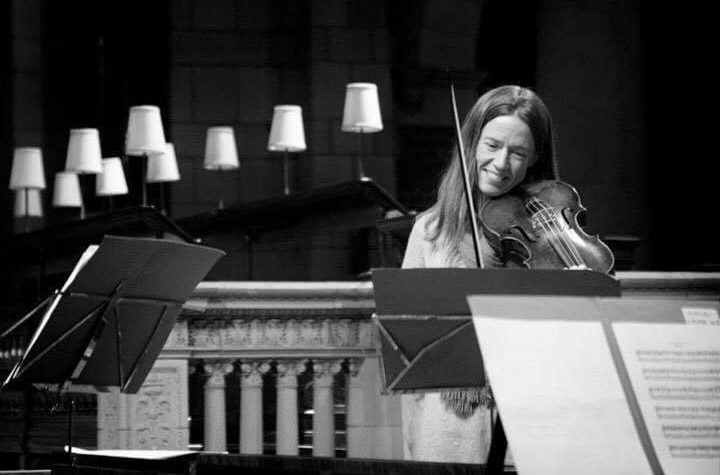
Kate grew up in Leicester and read English and French at Oxford, where she accidentally spent considerably more time with a viola under her chin than with a pen in her hand… A postgraduate diploma at Birmingham Conservatoire followed, and this led to a year in the European Union Baroque Orchestra, which launched her performance career. After a busy decade of playing, teaching and arts administration, alongside juggling two small boys and a modest selection of cats, she fulfilled a long-held ambition to train as a music therapist. She has gone on to work with diverse client groups, from premature babies to elderly adults, and is currently Clinical Lead for Music Therapy Works. Kate holds teaching posts at Royal Birmingham Conservatoire, the University of Birmingham and Bromsgrove School. She performs widely as a violinist and viola player, including with the period instrument collective The Musical and Amicable Society, which she co-founded with her harpsichordist husband in 2004. Although her diary looks bewilderingly varied at first glance, what ties it all together is a belief that people need music in their lives – and an irrepressible urge to help make that happen.
1. How long have you been a member of Ex Cathedra and why did you join?
When I first arrived as a student at the Conservatoire, I said yes pretty indiscriminately to every opportunity offered – and soon found myself sitting in Baroque orchestra, conducted by Jeffrey and coached by the wonderful Mica Comberti. They spoke about music in a way that was completely revelatory for me – as someone with a deep love of language, the realisation that I could actually play the words the singers were singing made me unfeasibly happy! The sheer joy of that discovery will never leave me. Some of my first professional concerts were with Ex Cathedra and I am immensely proud to have been able to maintain an association with such a flagship ensemble for 25 years.
2. What does a typical day look like for you?
I have consciously pursued a portfolio career – not least because I continue to find it impossible to say no to new opportunities! I rarely manage to wear a single hat for a whole day. You might find me delivering music therapy (currently in paediatric palliative care), or clinical supervision sessions. I might be teaching Baroque violin or examining at the Conservatoire, or lecturing on music therapy at Birmingham University. I might be working on a community outreach project, copyediting an article, or planning a training day. I might be fixing orchestral players or marking bowings into string parts (weirdly satisfying). I might be in a rehearsal or playing in a concert. I will always be trying (and failing) to stay on top of 6 different email accounts. When it all gets too much, you might find that I have flung myself into a lake to escape for a while!
3. If you could choose to perform any piece you have performed with Ex Cathedra again, what would it be, and why?
That’s an easy one: Bach’s Weinachtsoratorium! Which is serendipitous, given the timing of this interview… Nothing in the world makes me happier than playing Bach cantatas, so 6 in one go is literally like all my Christmasses coming at once! The interplay between music and text is utterly exquisite and there are always new details to discover, different nuances to enjoy in every performance. Returning to it with Ex Cathedra means the opportunity to share the journey through this extraordinary music once more with friends old and new. We will shape the story together – I know Bach could not be in better hands and voices.
4. What’s your musical guilty secret?
Being both a music therapist and a period instrument specialist means I have no trouble at all justifying my need to hoard random instruments. Some of these, like the antique accordion I fell in love with a few years ago (and the second, even prettier, one which followed me home shortly afterwards) are frankly aspirational in terms of my ability actually to play them. Others have proved easier to master, but are even more niche – including a collection of handmade French whistles, each designed to mimic the sound of a different bird’s song. I’m afraid I am unreasonably smug about my impersonation of a blackbird…